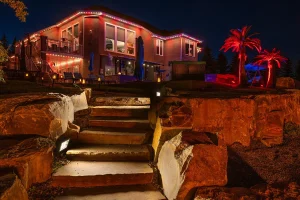
Most yards disappear the moment the sun goes down. The flower beds you spent all spring on, the tree that frames the house, the stone path to the front door: after dark they turn into shapes you can barely see. The benefits of garden lights start right there. A handful of well-placed lights makes paths safer to walk, gives you more usable hours outside, shows off the planting you paid for and lets you see your own property clearly at night.
- Safer Steps and Paths After Dark
- More Evenings Spent Outside
- Showing Off Trees, Beds and Stonework
- A Clearer View of Your Own Yard
- Getting the Benefits of Garden Lights Without the Runway Look
- Frequently Asked Questions
Safer Steps and Paths After Dark
The most practical reason to light a garden is so people can walk through it. Front walks, side paths to the gate, steps down to a patio and the edge of a driveway are all places where a missed step or an uneven paver is easy to find the hard way in the dark.
Path lighting does not need to be bright to work. Low, soft pools of light along the edge of a walk show where the ground changes, where the path turns and where the steps begin. Guests arriving for dinner, kids coming home after practice and anyone carrying groceries from the car all benefit, and nobody has to fumble with a phone flashlight.
Steps deserve particular care. A light that marks each tread, or washes the riser from the side, makes the change in height obvious without shining into anyone’s eyes. This is often where we start a landscape lighting plan, because it is the part of the yard people use every single night, whatever the season.
More Evenings Spent Outside
A patio or deck that goes dark at sunset is only half a room. Once the sky fades, people tend to head inside, even on a warm evening, simply because they cannot see the table or the yard around them. Garden lighting pushes that point later and turns the outdoor space into somewhere you can stay.
The trick is to light the surroundings, not just the seating. A softly lit hedge, a glowing tree at the back of the yard or a lit garden bed gives the space edges, so it feels like an outdoor room rather than a bright spot surrounded by black. That also means fewer harsh overhead lights pointed at the table, which is kinder on the eyes and on the neighbors.
The change shows up in ordinary routines. Summer dinners run longer, fall evenings by the fire pit feel less like a race against the dark, and the back yard becomes part of the house instead of a view through the window.
Showing Off Trees, Beds and Stonework
Gardens take years and money to grow, yet for half of every day nobody can see them. Lighting gives that work a second life after dark. A mature tree lit from below shows off its trunk and canopy. A low wall or stone feature lit from the side shows its texture. A planted bed with a few soft lights reads as a deliberate feature from the street.
From the curb, garden lighting also gives the house depth. A home with a lit roofline but a dark yard can look flat, while light at ground level pulls the eye through the front yard toward the door. It is one of the simplest ways to improve curb appeal without changing the house itself.
Choosing what to feature matters more than the number of lights. One or two strong focal points, such as a specimen tree or the front entry, usually look better than a light beside every shrub. We walk the yard at the onsite visit and pick the features that are worth the attention, then leave the rest in gentle shadow so the highlights stand out.
A Clearer View of Your Own Yard
A dark yard hides more than the flowers. When you hear something outside at night, being able to look out and see the side gate, the driveway and the back fence is a real comfort. Garden and pathway lights remove a lot of the deep shadow that makes a property hard to read from inside.
This is not about floodlighting the whole lot. A few lights placed near side doors, along the fence line and by the garage cover the spots that would otherwise be completely black. Combined with light from the house, they give a calm, even view of the yard. For owners who want more than that, our wider outdoor lighting work covers driveways, entries and the darker corners of a property.
There is a practical side too. Taking the trash out, letting the dog into the yard or checking on a delivery left at the side door all get easier when the path is lit. These small, nightly tasks are where a lit garden earns its keep long after the novelty of the install has worn off.
Getting the Benefits of Garden Lights Without the Runway Look
An easy mistake with garden lighting is lining both sides of a path with evenly spaced lights. It does the job, but it can look like an airport runway. Staggering lights along one side, or tucking them into the planting so the light falls across the path, looks far more natural.
Glare is the second thing to watch. A light you can see straight into is uncomfortable, while one aimed at a tree, a wall or the ground shows the object and hides the source. Warm white tones suit most gardens because they flatter plants, wood and stone.
Finally, think about the whole house at once. Garden lights work best alongside light from above, such as soffit lighting that washes the walls, so the house and the yard read as one picture. Planning both together avoids a bright house sitting over a dark lawn, or the other way around.
Ready to see what your yard could look like after dark? Our team at Halo Custom Lighting comes out for an onsite quote and demo, walks the paths, beds and trees with you and suggests where light will make the biggest difference. We plan the garden and the house together so the whole property looks finished at night. Take a look at our permanent outdoor lighting options and get in touch to book your visit.
Frequently Asked Questions
What are the main benefits of garden lights?
The main benefits are safer paths and steps, more usable evenings outside, better curb appeal and a clearer view of your yard at night. Each one comes from putting a modest amount of light in the right places rather than lighting everything.
Do garden lights help with home security?
Yes, in the sense that they let you see your property clearly at night. Lighting side gates, fence lines and the driveway removes the darkest shadows, so you can look out at night and see what is there. For stronger coverage near doors and the garage, we plan dedicated outdoor lighting alongside the garden.
How many lights does a garden path need?
There is no fixed number, because it depends on the length of the path, how many turns and steps it has and how bright you want it. A straight walk needs fewer lights than a winding one. We set the spacing during the onsite visit so the path is lit evenly without looking like a runway.
Should garden lights be warm white or cool white?
Warm white suits most gardens. It flatters greenery, wood and stone and feels relaxed on a patio. Cooler white can look harsh on plants, so we usually keep it for spots where clear, practical light matters more than mood.
Can garden lights be planned with roofline lighting?
Yes, and planning them together gives the best result. Light from the roofline washes the walls while garden lights fill the yard below, so the house and the landscape read as one design instead of two separate projects.